
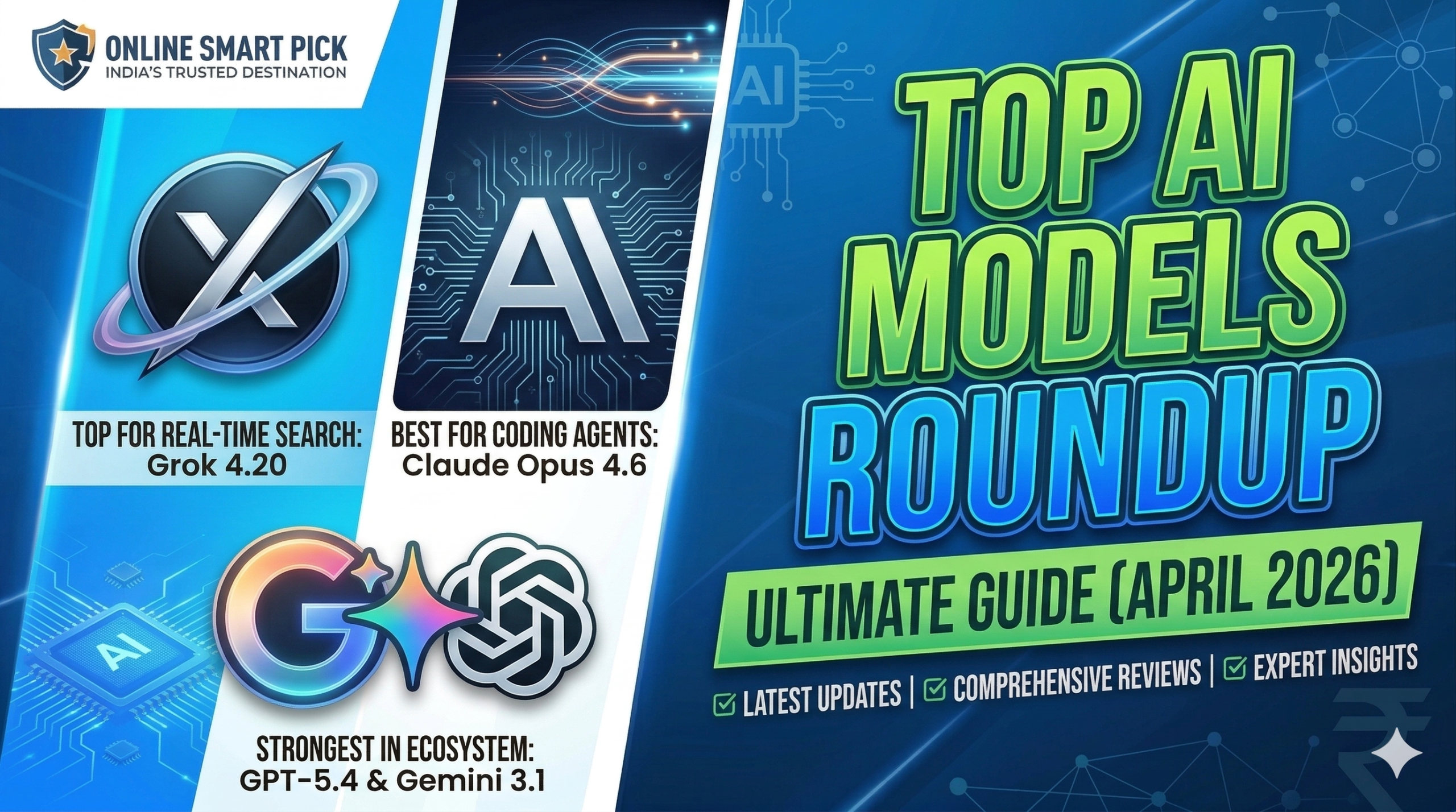
The AI race in 2026 is moving at breakneck speed — new flagship models, billion-dollar compute clusters, open-weight challengers, and surprise leaks. Here’s your no-fluff roundup of the five biggest AI model families as of early April 2026.
1. Grok — xAI (Elon Musk)
xAI’s current flagship is Grok 4, released around July 2025. It comes in multiple variants — Grok 4.1, 4.2, and the speed-optimised Grok 4 Fast. For heavy reasoning tasks, Grok 4 Heavy is the top pick. Hallucination rates have dropped significantly, and select modes now support up to 2 million token context windows.
What’s coming: Grok 5 is expected in a Q2 2026 public beta (May–June window). Rumours point to a ~6 trillion parameter Mixture-of-Experts (MoE) architecture, trained on xAI’s expanded Colossus 2 supercluster running up to 1.5GW of compute. It was originally planned for Q1 but got delayed.
Other highlights:
- Text-to-video generation (up to 15 seconds) via Grok Imagine
- Real-time web and X (Twitter) search integration
- Image generation now restricted to paid subscribers due to misuse concerns
- xAI raised $20 billion and launched Business/Enterprise tiers
- Deeper X platform integration is described as the “most important change” to X
- Some regulatory scrutiny in Europe over content policies
Grok positions itself as the most truth-seeking, least-filtered AI among the major players. A free tier exists with limits; full access requires Premium+ or the app.
Best for: Users who want real-time, unfiltered answers with live social data from X.
2. Claude — Anthropic
Anthropic had an extremely active Q1 2026 — shipping over 120 new features, largely focused on Claude Code (agentic coding with multi-agent support, remote control, and enterprise policy controls). The current flagship models are Claude Opus 4.6 and Claude Sonnet 4.6.
Opus 4.6 leads on benchmarks like SWE-bench (software engineering tasks) and scores high on reliability. Standard context window goes up to 1 million tokens. Notably, cross-chat memory is now available even on the free tier.
Recent developments:
- 120+ features shipped in Q1 2026, focused on agentic coding workflows
- Memory across conversations now on the free tier
- Partnership with Australia on AI safety research
- Late March 2026: Accidental leak of Claude Code source code
- Internal docs surfaced mentioning “Claude Mythos” — reportedly a ~10 trillion parameter model focused on cybersecurity — and a “Capybara” pricing tier. Anthropic issued takedowns.
Claude 5 Opus is expected sometime in the Q2–Q3 2026 window.
Best for: Coding, long-context document work, and users who prioritise safety-first AI design. Sonnet 4.6 is the everyday sweet spot for speed and intelligence.
3. ChatGPT / GPT — OpenAI
OpenAI rolled out the GPT-5.4 series in March 2026, consolidating its lineup into a unified family with three main variants:
- GPT-5.4 Thinking — deep reasoning via test-time compute
- GPT-5.4 Pro — full-capability flagship
- GPT-5.4 mini — fast, lightweight, cost-efficient fallback
Hallucination rates are down, and the model now natively handles computer use and agentic desktop workflows — reportedly outperforming humans on certain OS-level benchmarks.
What’s new in April 2026:
- Apple CarPlay integration — a major consumer milestone
- o3-pro reasoning model enhancements rolled out
- Enterprise Codex seats for coding automation now available
- Some legacy o-series models retired, then partly restored based on user feedback
OpenAI’s stated roadmap is to simplify the model lineup and push toward a full “super-assistant” agentic experience. Massive new funding rounds are reportedly in progress.
Best for: The broadest ecosystem integration of any AI. GPT-5.4 Thinking for complex reasoning; mini for fast everyday tasks.
4. Gemini — Google DeepMind
Google’s current generation is the Gemini 3.1 series — available in Pro, Flash Live, and Flash-Lite variants. Gemini’s standout strength is multimodality: real-time voice analysis, live image understanding, and seamless integration across Google Docs, Sheets, Maps, Search, and Android. The platform has reached approximately 750 million users.
Recent highlights:
- Search Live expanded with real-time results
- “Personal Intelligence” — proactive, personalised assistant features launched
- Tools added to make it easier to switch from competing AI assistants
- March 2026 updates focused on daily helpfulness and healthcare applications
Gemma 4 — Released April 2, 2026: Google’s open-source model family just received a major upgrade. The new 31B and 26B variants are the most capable open models Google has released, optimised for reasoning and agentic workflows. Some configurations can run on a single GPU. Licensed under Apache 2.0.
Best for: Users already in the Google ecosystem. Gemma 4 is a standout for developers who want open-weight performance without ongoing API costs.
5. DeepSeek
DeepSeek consistently punches above its weight. The V3 series proved that frontier-level performance doesn’t require US-scale compute — making it a direct challenge to Western AI dominance. Its open-weight approach has earned a strong developer following, especially for coding tasks.
What’s coming very soon: DeepSeek V4 — expected in April 2026. It will be a full multimodal model covering text, image, and video generation. The notable twist: V4 will run on Huawei Ascend chips instead of Nvidia GPUs, a direct response to US semiconductor export restrictions. Training faced hardware challenges but the team pivoted successfully.
This hardware pivot is more than a technical choice — it’s a strategic signal of China’s push toward AI independence from Western chip supply chains.
Best for: Developers who want top-tier open-weight performance at a fraction of the cost. V4’s multimodal capabilities could make it a genuine challenger to GPT-5.4 and Gemini 3.1.
Quick Comparison: All 5 Models at a Glance
| Model | Company | Current Best | Next Release | Open Weight? | Best For |
|---|---|---|---|---|---|
| Grok 4 | xAI | Grok 4 Heavy | Grok 5 — Q2 2026 | No | Real-time, unfiltered |
| Claude 4.6 | Anthropic | Opus 4.6 | Claude 5 — Q2–Q3 | No | Coding, long docs, safety |
| GPT-5.4 | OpenAI | 5.4 Thinking / Pro | Super-assistant roadmap | No | Broadest ecosystem, agents |
| Gemini 3.1 | Gemini 3.1 Pro | Gemma 4 (live now) | Gemma 4 ✅ | Multimodal, Google products | |
| DeepSeek V3 | DeepSeek | V3 series | V4 Multimodal — Apr ’26 | ✅ Yes | Cost-efficient, open dev |
Final Thoughts
The gap between the top AI models is narrowing fast. What separated them 12 months ago — reasoning quality, context length, multimodal support — is now table stakes. The new battlegrounds are agentic workflows, hardware independence, and cost efficiency.
Whether you’re a developer, a business owner, or just someone who wants the best AI assistant, there’s never been a better time to experiment. Each of these five models has a distinct personality and use case — and the best one for you depends entirely on what you’re trying to do.
We’ll keep tracking updates as they roll in. Bookmark this page — it’ll be updated as Grok 5, Claude 5, and DeepSeek V4 launch.

